
What is SLS 3D Printing?
SLS (Selective Laser Sintering) is an industrial 3D printing technology that uses lasers to fuse nylon powder into solid objects, layer by layer. The process is ideal for functional prototypes, τελικά εξαρτήματα and spare parts, as it offers great mechanical strength, high detail and no need for supports.
Advantages of SLS 3D Printing
SLS is one of the most advanced and reliable 3D printing technologies. Some of its key advantages include:
✅ Small to medium scale production – ideal for 10-100 pieces
✅ High mechanical strength – suitable for industrial use
✅ No need for supports – unsupported geometric shapes are possible
✅ Detail and accuracy – ideal for complex components
✅ Smooth surface – good base for painting or finishing
Supported materials
The most common powder for SLS is Nylon PA12, but there are other options depending on the application:
- PA12 – durable, elastic, suitable for everyday use
- PA12 GF – reinforced with glass fibers for greater rigidity
- TPU (rubber) – for flexible parts
- PA11 – impact and moisture resistant


Where is SLS technology used?
SLS technology is applied in many areas where precision and durability are required:
🏭 Industry & Engineering – prototypes, tools, components
🚗 Automotive industry – brackets, air ducts, protectors
🦷 Dental/Medical – custom brackets and models
🛠 Parts for machines or electronics
🧪 Laboratory applications – housing for sensors and instruments
Why choose Get3D for SLS?
Στην Get3D διαθέτουμε πολυετή εμπειρία στην εκτύπωση λειτουργικών πρωτοτύπων και τελικών προϊόντων. Επιλέγοντας εμάς για την εκτύπωση SLS:
- You ensure consistent quality in every print
- You have technical support for your model
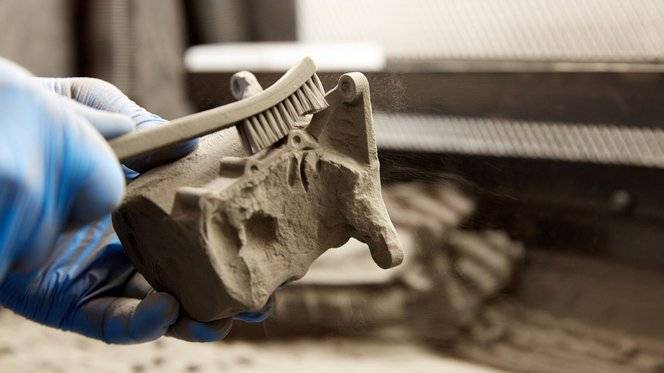
- We provide professional post-processing
- We have fast production times
- You can also request mass production with a flat cost per piece
Online costing
Do you have a file?Upload your file, learn about the materials and appropriate technology and receive a comprehensive offer from our experienced team.
"If you don't have a file, we can create it for you via 3D Design»
SLS 3D Printing Cost
Cost depends on:
- Object volume (cm³)
- Material selection
- Quantity and post-processing
Standard delivery time
The production and shipping of SLS prints is usually done in 5–7 business daysIn case of large quantities or special processing, contact us for a personalized schedule.
Contact us
If you need advice on how to design your model for SLS, or if you want to know if your file is suitable, we are at your disposal!
Frequently Asked Questions (FAQ)
What is the difference between SLS 3D Printing and other 3D printing methods?
At SLS printing uses a laser to melt nylon powder and bond it in layers. Unlike FDM or SLA, it does not require supports and offers superior mechanical strength and surface uniformity.
Which material is better for SLS: PA12 or PA11?
PA12: Classic, reliable, with good durability and chemical stability.
PA11: More flexible and impact resistant – ideal for dynamic parts.
The choice depends on your application. For more hard or functional parts, PA12 is usually more suitable.
How can I reduce costs in SLS printing?
- Optimize the volume of the model (smaller = cheaper)
- Replace solid areas with hollow geometry
- Group prints (for volume discounts)
- You can see prices in real time with our tool Online 3D Print.
How durable are SLS parts?
The items from PA12 via SLS present excellent mechanical strength, heat resistance, and lifespan. They are fully functional for finished products and not just for prototypes.
Is SLS suitable for mass production?
Yes. SLS is one of the most productive 3D printing technologies, as it allows for the compact placement of many components in a chamber, without supports. You can produce 10, 50 or even 100 pieces with high repeatability.
How quickly can I receive it?
Most orders are shipped within 2–4 business daysIf it is about large quantity or custom post-processing, contact us for a schedule.
Can you paint or do other finishing?
Of course! At Get3D we offer:
- Dyeing for permanent color
- Paint (in black, gray, RAL colors)
- Standard surface finish
- Polishing (on selected components)

 Greek
Greek